There's a quiet logic to why one necklace feels right and another feels slightly off — and it has very little to do with price. More often, it comes down to length, pendant scale, and how a piece interacts with your neckline and the proportions of your face.
This guide is a practical framework rather than a set of rigid rules. Faces don't read from a chart, and the best piece is ultimately the one you reach for. But understanding a few principles makes the decision far easier — especially when you're buying online and can't try things on.
Start with length, not the pendant
Necklace length is the single most influential variable, and it's the one people overlook most. A common mistake is choosing a beautiful pendant on a chain that sits at the wrong place entirely.
Here's a simple way to think about the standard lengths:
- Choker (14–16"): Sits high on the neck. Draws the eye upward and works beautifully with open necklines.
- Princess (17–19"): The most versatile length. Falls just below the collarbone and suits almost everyone.
- Matinee (20–24"): Lengthens the upper body and pairs well with higher necklines.
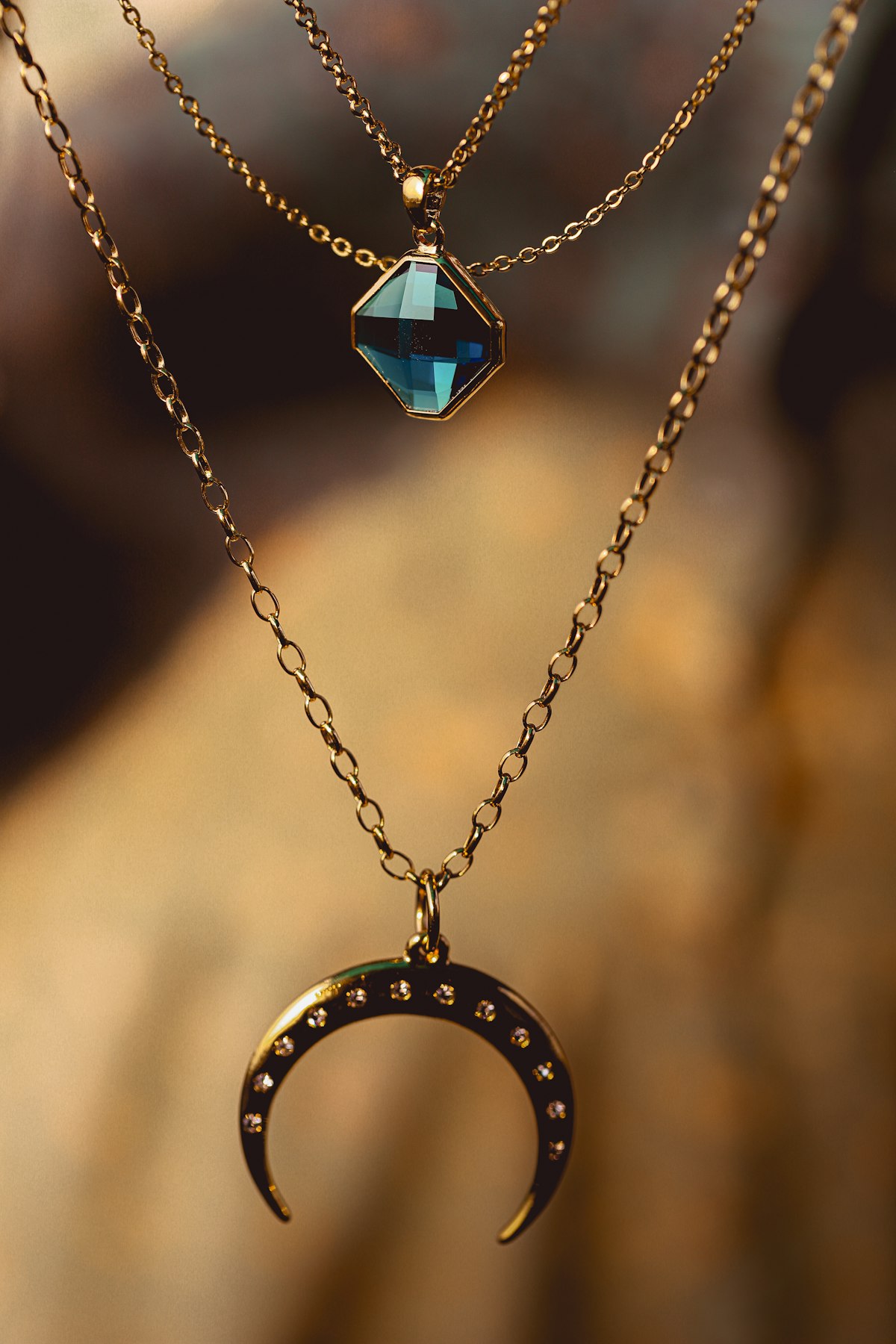
- Opera (28–36"): Dramatic and elongating; can be doubled for a layered look.
Matching length to face shape
The principle is one of balance — you generally want to counter your strongest feature rather than echo it.
Round faces
Longer chains and pendants that create a vertical line are flattering, since they add length and draw the eye downward. A princess or matinee length with a slim drop pendant works especially well. Short chokers tend to emphasize roundness.
Oval faces
Oval is the most adaptable shape — most lengths work. This is your chance to experiment with chokers and statement collars that other shapes can't always carry.
Square and angular faces
Softer, rounded pendants and curved chains help balance a strong jaw. Avoid sharp geometric pieces that repeat the angles of the face.
Heart-shaped faces
Pieces that add a little visual width lower down — a cluster pendant or a wider collar — help balance a narrower chin.
Pendant scale: the detail people miss
A pendant should feel proportional to your frame. Petite frames are often overwhelmed by oversized statement pieces, while a delicate pendant can disappear on a larger frame. When buying online, always check the listed pendant dimensions in millimeters rather than trusting the photograph — product images are frequently shot close-up and read larger than life.
Buying online with confidence
Because you can't try before you buy, a few habits reduce disappointment considerably:
- Note the exact chain length and pendant dimensions, and measure them against a necklace you already own and love.
- Check the clasp type — lobster clasps are more secure than spring rings for everyday wear.
- Read the material description carefully (we cover silver versus gold here).
- Look for a clear return policy, since fit is genuinely hard to predict from a screen.
The bottom line
Choosing a necklace well is mostly about proportion and intention. Get the length right first, keep the pendant scale honest to your frame, and let your neckline guide the rest. Do that, and the piece will feel like it was made for you — which is exactly the point.